Grimma to Dresden
"I buckled on my knapsack in Grimma, and we set off"
"I buckled on my knapsack in Grimma, and we set off"
Dresden, 9 December 1801.
In Grimma I strapped on my knapsack(1), and off we went. A caravan of good-natured, cheerful people accompanied us over the hills of the Mulde valley(2). Friend Großmann(3) talked at length with my friend Schnorr(4) about matters from the sanctuary of their goddess, of which I, as one of the uninitiated, understood very little. Unnoticed, I stole a few minutes for myself, sat down up there opposite Saint George’s great dragon(5), and prayed my traveller’s prayer:
“that Heaven might grant me fair and friendly innkeepers and courteous gate clerks(6) from Leipzig all the way to Syracuse, and back again by the other road to my own country; that it might preserve me from the hands of those monarchic and those demagogic benefactors of mankind, who with equal despotism clap their system upon us ordinary folk’s noses, as the Samoyed(7) fastens a ring through the noses of his animals.”
Then I looked back over the beautiful country which Melanchthon(8) had already found so delightful that he wished to live there; and in my mind I quickly ran through all the happy days I had enjoyed in that same place: toil and vexation are soon forgotten. There stood Hohenstädt(9) with its handsome clusters of houses, and on the slope appeared Göschen’s splendid estate(10), where so often we dug and planted and weeded and talked and harvested, and ate potatoes and peaches. Friendly villages lay around the hills, and the river wound down through the mountain gorges, where not a path or an oak tree was unknown to me.
The sun shone warmly, as in spring, and we took leave of our companions gratefully and with the brightest hope of returning. Once more I looked to the left, towards the new mill on the highest rise, which from our garden house in Hohenstädt had so often marked the limit of our view across the valleys. Then we walked quietly down the road towards Hubertsburg(11). In Altmügeln(12) we were received with patriarchal warmth, entertained with the friendship of youth, and sent on the following morning, to a beautiful melody from Goethe’s song—“Kennst du das Land?”(13)—and with the warmest wishes, onwards to Meissen(14), where we received an equally warm welcome. If only we could have those kind friends join us on Sicily’s southern coast! The Elbe rolled majestically down between the Dresden hills. The heights gleamed as though the buds were just about to burst out again, and smoke rose from the river towards old Scharfenberg(15). On 8 December the weather was so sultry that it was a great relief to pass out of the sun and into the shade of the forest.
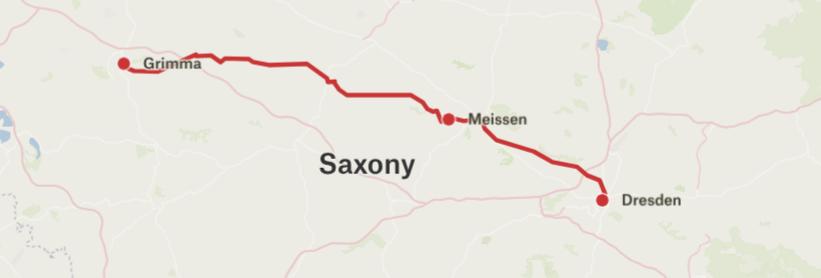
Grimma to Dresden, via Meissen.