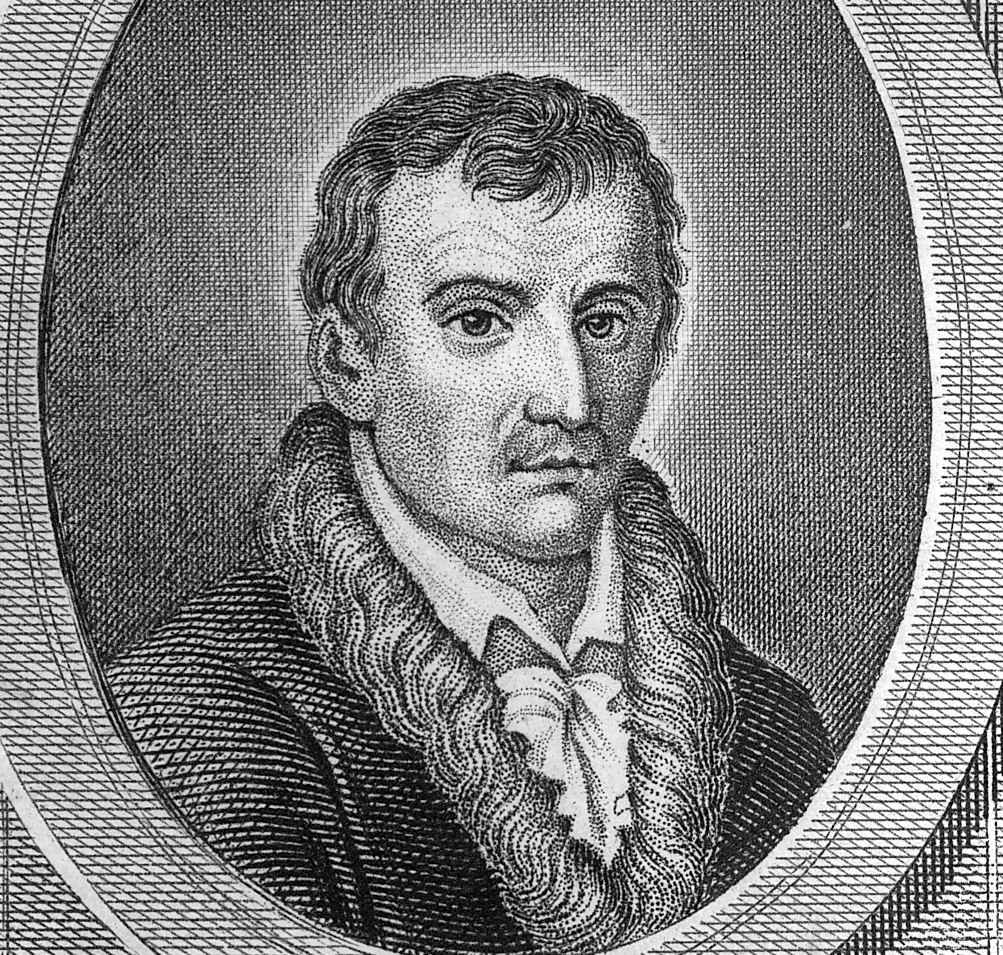
Seume was my friend, and I was his, in the true sense of the word: our friendship was founded on a shared, deep feeling for honesty and integrity.
I was his companion as far as Vienna, where I had to remain behind on the advice of several influential men to whom I had been recommended. Allow me, then, to follow Seume farther in spirit and here and there to add a word for those readers who take an interest in him.
My notes concern only the traveller’s individual character. I may perhaps justify my sense of qualification for the task by mentioning that Seume was my table companion for nine years and was in my house every day.
He is no more, and I and my family have lost a faithful friend.
Schnorr’s notes
SN1
No one who knew Seume well would deny it: nowhere was he more at ease than in the domestic circle of an upright family. Nor was he nearly as morose as some may have believed. When asked, he would even take part in the performance of little farces, sometimes as writer and sometimes as actor.
Once he took the role of the herald when, in the beautiful, romantic country near Grimma, at Pöhlen, we performed Don Quixote in the open air in the most fantastic costumes. He himself played Cleopatra, moustache and all, when we staged a farce by Kotzebue in Hohenstädt to give our friend G. a cheerful hour.
For all his gloomy expression and generally serious manner, even small children soon approached him, and he clasped them in his arms with deep and heartfelt affection.
His greatest sorrow was not to have a wife and child of his own. Fate had not favoured him, and in this respect he had suffered bitter experiences. This is already evident in his early poem The Farewell to Münchhausen. In his later poems, and especially in the present book, he expressed himself more plainly about it here and there.
He once said to me: “If it were not against my principles, I should like to have a son by a healthy peasant girl.”
Seume was a thoroughly moral man. When he heard of an act of noble humanity, his response was brief: “Well, that is reasonable! That is humane; that is good!” But his heart was warmed by it.
The event in Messina which he himself relates in this book gave him one such heart-lifting celebration of joy. He always used to say: “Goodness praises and rewards itself.”
But baseness, degradation, and any violation of human dignity made him gnash his teeth with inward rage, tolerant though he always was in judging human weaknesses.
The welfare of humanity, founded on universal justice and freedom—which, in his view, were virtually synonymous—lay very close to his heart. Yet he was prudent. He never entered into political or religious discussions with ordinary people. “That can do no good there,” he used to say. “What is reasonable must come from above and be made universal.” He did not even give his writings to his mother or relatives. “You do not understand such things,” he said. “Obey the laws and go to your church.”
He was never satisfied with the hasty, self-styled Enlighteners; he disturbed no one’s faith and held upright, conscientious preachers in high esteem.
Beneath the portrait of his mother, which I had drawn and etched for him as a keepsake about fifteen years earlier, he had the following inscription engraved:
Regina Christina Seumin.
Love and respect for parents; loyalty to friends; reverence for religion; obedience to the laws; courage for the fatherland; justice and humanity towards all.
I often heard him say: “What should I do with an office here—or there—or, heaven forbid, at court? It would last four weeks, and—you would see me back again.” It was impossible for him to make concessions in public affairs, so he preferred to avoid such conflicts. Once he was invited to write a political and literary newspaper. He politely declined, however great the promised profit and brilliant the prospects held out to him. Seume would have lectured excellently on natural law—he had a great desire to do so—but it would soon have been forbidden, and anything he wrote would have been confiscated.
The most suitable post for him, I think, would have been an inspector of public roads. I am convinced that, even if we might not have had Spanish highways, we should at least have had better roads at home; all travellers agree that they are sometimes very poor indeed.
The happiness of humanity occupied him above all else. His heart was full of the idea of universal justice. At times great hopes inspired him, however far into the future he placed the arrival of better days.
Yet he was not idle and did a good deal of good. Several young men of heart and intelligence whom he taught, and who became very honourable and worthy people, acknowledged that they owed an immense debt to Seume’s upright, steadfast principles. Even many young noble students—whom he certainly never flattered at any price—kept returning out of genuine respect for the man and his principles. In short, Seume enjoyed universal respect as a man of acknowledged integrity, and I confidently hope that it will remain his for ever.
When General von Schwerin—a nephew of the celebrated great Schwerin—was in Leipzig about ten years ago and sat to me for his portrait, he asked after Seume. I showed him a few of Seume’s letters. “Yes, yes! That is his hand,” he said. “I know it.”
Seume himself recounts in My Summer, his last journey to Russia, the unfriendly treatment he received from old Igelström on his return journey from Russia. Such—not all that rarely—are the rewards for honest and faithful service!
That was said in a moment of moral indignation, when his imagination and the memory of so many affronts to human dignity, especially in capital cities, came rushing in upon him. He felt this deeply at the time and gives expression to that feeling here. But he by no means intended to insult an entire city, as should go without saying.