Deutschbrod to Znaim
"Here in Znaim I had to drink wine for the first time, because the drink of the Germanic gods was no longer to be found in Valhalla."
"Here in Znaim I had to drink wine for the first time, because the drink of the Germanic gods was no longer to be found in Valhalla."
Passing through Iglau(1), I saw nothing but the large, handsome, bright market square. Its houses, however, look far better from a distance than close at hand, like almost everything in the world that aspires to magnificence without possessing strength. Near the middle of the square stands a splendid Trinity monument from the time of Leopold I(2) and Joseph I(3), as devoutly Christian as could be, but as dismal as barbarism. Some finer details were cracked and daubed, but the conceptio immaculata and the sponsa spiritus sancti still stood firm and intact beneath the Ave Maria, to the consolation of the faithful. A quite good wine is said to grow near Iglau; but it cannot be produced in quantity, for I saw few vineyards in the area.
Half an hour this side of Iglau, at the frontier, stand two pyramids not far from one another, erected in 1750 under Maria Theresa(4) by the Bohemian and Moravian estates.(5) The inscriptions are genuine modern diplomatic Latin and already so badly faded that in a hundred years scarcely anything will be legible—although, as usual, they were set up for eternal remembrance. Throughout Moravia there seems to me to be more liberality and good nature than in Bohemia.
In the little town of Stannern(6) there must be substantial woollen manufactures, for all the windows are hung with these goods, while caps, stockings, gloves and the like are offered for sale at extraordinarily low prices. A good, comfortable inn—the first we had encountered since leaving Prague—immediately raised the town in our estimation. Anyone who does not travel by express post but trudges stubbornly onward on foot must very often make do like a Huron. My greatest fear, however, is the rather repulsive billeting of certain small white creatures with black saddles, which flourish particularly well in Poland and are said not to be uncommon in Italy either. Otherwise, it is much the same to me whether I roll about on eiderdown or bean straw. Sed quam misere ista animalcula excruciare possint, apud nautas expertus sum;(7) that is presumably why the Greeks gave them their destructive name.
Here in Znaim(8) I had to drink wine for the first time, because the drink of the Germanic gods was no longer to be found in Valhalla. The wine—one measure for twenty-four kreuzers(9) —was very good, as Schnorr assured me;(10) for I understand nothing of it and drink the best Burgundy with water just as I do the worst Potsdam stuff. I could well live here, so lovely and welcoming is the whole region, even under snow. On one side the town adjoins fairly substantial hills; on the other, especially towards Austria, the surroundings are made very picturesque by the many vineyards planted along gentle slopes.
The two monasteries at opposite ends of the town occupy excellent sites, as monasteries generally do. Joseph II suppressed one of them, on the Austrian side, along with others.(11) Its buildings are so stately that they would not seem unworthy as the residence of a minor prince. During the war they served various purposes, sometimes as a supply depot and sometimes as quarters for prisoners; now everything stands empty.
The Roman ruin shown here lies two hours outside the town, down to the right in a beautiful area. Since I do not intend to study Roman ruins in Moravia, I continued on my way. I hear that a local canon has interpreted it, and I refer you and your curiosity to him.
Judging by the many fine vineyards throughout the district, and now hearing that the ruin was interpreted by a canon, I should almost believe blindly that it must have had something to do with the Dionysia. Since the soil beneath the great, extensive vineyards seems excellent everywhere, it could surely be put to better use than wine-growing. The poor ought to have bread before the rich have wine; and abbots and canons can have neither sense nor vote on that question.
At the border between Moravia and Austria I found no marker; only the roads immediately become noticeably worse than in Bohemia and Moravia. The vineyards seem to me to waste a dreadful amount of good land. I judge the matter as a philanthropist, not as a drinker or a man living on interest. Bad paving, which cannot have been repaired for a long time, passes for a highway.
I shall give you two small examples of how plentiful good coin, and gold in particular, is here. Yesterday I paid for my midday meal in good ten-kreuzer pieces, which are not especially sound even in Saxony. A peddler saw this, pointed out how much I was losing, and—when I assured him that I could not help it and did not mind the small loss—hastily took away the good tens and laid down new, bad twelve-kreuzer pieces for the landlord, who was not present.
On another occasion, in an inn where cleanliness, prosperity and even abundance prevailed, and where we had been well fed, I asked the rate for ducats because I lacked small change. The landlord answered very honestly: “I truly cannot tell you, for I have not seen any gold for many years—nothing but bad money and paper—and I do not wish to cheat you with the old rate.” The man was doing very well with bad money and paper and was content without troubling himself about ducats.
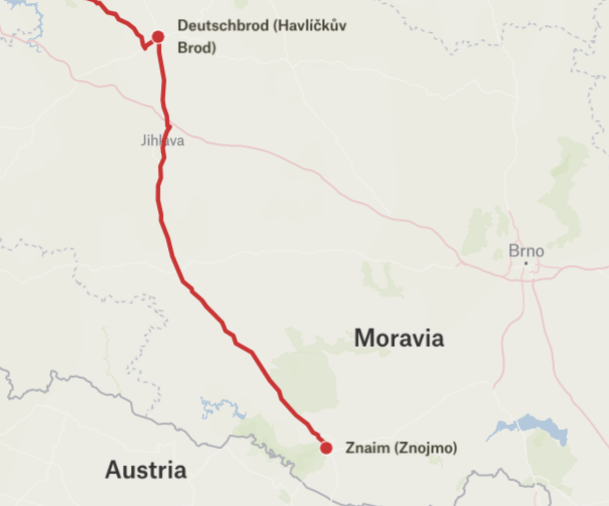
Deutschbrod (Havlíčkův Brod) to Znaim (Znojmo).