Prague to Deutschbrod
"The Bohemian inns do not enjoy the best reputation."
"The Bohemian inns do not enjoy the best reputation."
We took our friends’ blessing with us and continued our pilgrimage from Prague. Naturally, I cannot tell you about places where I saw nothing. A night’s lodging is a night’s lodging; and whether we ate ham or sausage, or both together, can matter very little to you.
It was a beautiful, glorious, fresh morning when we passed through Kolín and the country around the battlefield.(1) Daun knew how, with great skill, to turn all his battles into positional engagements,(2) and Frederick experienced the formidable genius of this Cunctator more than once.(3) Had he not been wounded at Torgau,(4) there would probably have been a second edition of Kolín. I found the country from Kolín to Čáslav(5) very pleasant; above all, the villages on the right in the valley make a fine sight. The last but one rise before Čáslav affords a magnificent view to right and left, forward and back, across a fertile plain dotted with villages and towns. It seems to me that this would be one of the finest military positions: one could sweep down from it so readily and effectively in every direction. I should be very surprised if the spot did not appear somewhere in military history.
Not far from Kolín I ate my midday meal at a roadside inn, without paying much attention to the food. My mind was in a strange and very mixed state, not without melancholy amid the terrible scenes of the past. Then, from a corner of the large, dark room, there came to me faint, trembling music of a simple magic. I confess my weakness: a single note can sometimes melt my soul and lead me like a child.
An old Bohemian woman sat at a brighter window opposite us, drying her eyes, and a young, beautiful girl, probably her daughter, seemed gently to comfort her with looks and words. At that distance I caught only a few things through the language’s resemblance to Russian, which, as you know, I was once obliged to learn a little.(6) Emotion seldom breaks through in me unless humanity carries me irresistibly away. I help where I can—if only I could do so more often. The sound of the old instrument, played by a fair-haired young fellow in the other dark corner, may have affected the women more deeply and intensified their peculiar mood. It was neither harp, lute nor zither; no one could tell me its proper name, but it most resembled the Russian balalaika.(7)
It seems to me that others have already remarked that the road from Prague to Vienna is perhaps the busiest in all Europe. We encountered an endless number of wagons with Hungarian wines, wool, and cotton; but most of them were bringing flour to the magazines at Čáslav and further on toward the frontier.(8)
The Bohemian inns do not enjoy the best reputation, and between Dresden and Prague we had already once been forced to eat, drink and sleep rather like the Cynics. We were comforted with the assurance that in Deutschbrod(9) we would find a very good house; but never was such a good hope so badly fulfilled. We tried two inns, neither of which looked particularly inviting, and could get no room; the officers, we were told, had taken everything while passing through. That may well have been so, for everyone was returning home from the army—hence the unsafe roads.
At the third inn I crossly put my knapsack straight down on the table and installed myself without a word. The landlord was a dauber who called himself a painter, and his mother was a model of an old, ugly, quarrelsome woman who for forty years had already passed from the sixth petition into the seventh.(10) After us came a crowd of Jews—glass dealers, tray-peddlers and box-carriers of every kind—one of whom claimed to trade as far as the Yenisei in Siberia.(11) The company drank, sang and quarrelled at full volume, without caring a fig for my aesthetics; and at night they packed us so tightly on the straw with the Hebrews that I had scarcely been packed in more oppressively aboard the British transport ship to America.(12) Such evenings and nights had to be allowed for when we fastened our travelling packs.
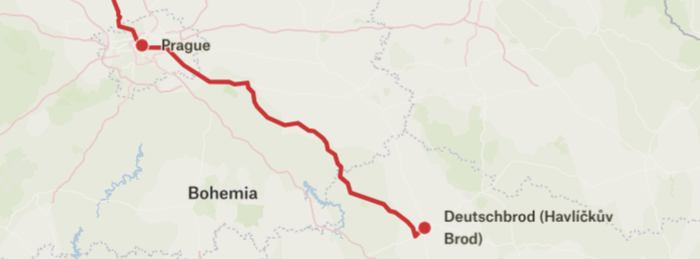
Prague to Deutschbrod (Havlíčkův Brod).