Dresden to Lowositz
"The Bohemian-German dialect as far as Lowositz is rather agreeable."
"The Bohemian-German dialect as far as Lowositz is rather agreeable."
Written in Budin.
In Pirna we spent an hour with Herr Siegfried,(1) whom you know as the author of Siama and Galmori, and who, with several acquaintances, escorted us to the border. Then the road began to climb; and although it had been mild down by the river, the weather was harsh above. Within a few hours we were already in snow. It grew deeper until a few hours beyond Peterswalde,(2) then gradually lessened, and ceased entirely again near Aussig.(3)
I had been given very strange ideas about the conspicuous manifestations of Bohemian Catholicism. I noticed nothing of the kind. On the contrary, I must say that everything pleased me exceedingly. Our inn at Peterswalde was as good as anyone with reasonable expectations could wish. The customs officer who endorsed my passport was friendly, the meal was not bad, and the serving girl was charmingly neat and pleasant. Laugh at this observation if you will, you old grumbler! A person would need a very sour and unaesthetic soul not to prefer a young, pretty, friendly face to an old, ugly, morose one. In our room, before a mirror hanging between two pictures of the Virgin, the girl adjusted her little silver cap with such charming innocence—as though, in all honour, she were quite willing to forgive herself a little disorder. The heretic Schnorr(4) gazed so rapturously into the eyes of this true-believing creature that one might have thought he was about to convert to her faith—or at least make her his model.
Moreover, the Bohemian-German dialect(5) as far as Lowositz is rather agreeable; it does not gurgle out the words half so thickly and unpleasantly as the mountain speech in Saxony.
The road from Peterswalde to Aussig (SN5) is rugged but beautiful; from Aussig—where one rejoins the Elbe(6)—romantically wild, with high mountains rising left and right along the river, full of ravines, cliffs, and sharp peaks. Here I was told of the complaint against the indiscipline of our Saxon compatriots, who during the Bavarian War of Succession(7) burned all the vine-stakes here for firewood. They need only have climbed a few hundred paces higher to find whole forests. Such things pain me to the depths of my soul on behalf of others. If the Austrians behaved just as badly, that does not make us any better. When will our humanity at last wipe away such stains?
At Lowositz(8) the mountains gradually come to an end; from there up toward Eger(9) and down toward Leitmeritz(10) there is beautiful, magnificent, fertile country, which two hours beyond Budin(11) becomes entirely flat. In Budin—a place where utter desolation seems to reign—I found a small collection of good books in the home of Lasar Tausig, a Jewish resident. As he had lent Lessing’s Nathan the Wise(12) to a friend, he gave me instead, for the evening, Kant’s The Only Possible Argument in Support of a Demonstration of the Existence of God.(13)
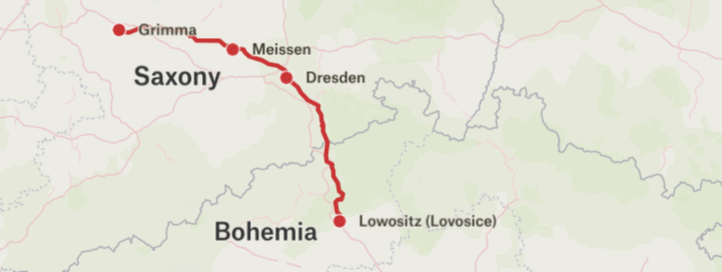
Dresden to Lovosice, through Pirna, Petrovice and Ústí nad Labem.